
Handwritten narratives — and the voices behind them — from the artists, organizers, DJs, and unsung heroes who shaped the Pacific Northwest’s music and arts scenes (1985–1995).
Vocalist - Hammerbox, Goodness and The Rockfords
Carrie Akre
Coming soon!
Cathy Faulkner
Radio Personality - KISW
When I was on the radio at KISW, people knew me as the late Kathy Faulkner. Whether one calls it a nickname or a radio name, its origin is one I'm extremely proud of. I started at KISW in the early 80s at the age of 15 answering phones for Steve Slayton, the boss with the hot sauce. That was his nickname. It was my dream to not only work at KISW but to be on air, providing your musical soundtrack. Well, I paid my dues and after a couple years I finally got a weekend shift. So the question is, what would be my radio name? After some ideas were tossed out, I decided to use my own name, mainly out of fear that someone might call me by my radio name and I would ignore them or wouldn't respond. Steve Slayton was notorious for blessing or anointing the air staff with the perfect nickname. For example, Damon Stewart, the new music guru. Bo Roberts, baby Bo Roberts. So when I finally locked my first full-time on-air shift Monday through Friday 10 p.m. to 2 a.m. in 1987, I became the late Kathy Faulkner or late Kate for short. At the time, Late Night for David Letterman was hugely popular and I believe was a big motivation to my nickname. I worked late at night. Obvious connection. Another benefit of having the nickname the late Kathy Faulkner was I didn't really have to show up on time. I could use my nickname as an excuse. As the years rolled on, occasionally someone would hear "the late" and assume the worst happened to me, that I had expired. Condolence cards or bouquets would sometimes arrive at the radio station. Working at KISW at that time didn't allow for much of a social life, so personally I really enjoyed the flower bouquets. When I sent a thank-you note to the person who sent the condolence bouquet, I'm sure it scared the crap out of many a well-wisher, I got to be on a air and ultimately music director for one of the most amazing times in music history, especially Seattle music history. To have a friend in the music community, now obviously many a music icon, call me the late or the late great, was the absolute ultimate nod of respect. When on stage introducing a band, nothing was more amazing and awe-inspiring than hearing the audience respond after I would say my name. In fact, my son got to see me do a stage announcement and said that the crowd sounded like a cult following after hearing me introduce Alice in Chains once. I am a huge fan of music. I am a huge fan of the Seattle music scene and I am a huge fan of KISW. There is no greater honor than being able to have a radio relationship with an audience who loved music just as much. I'm absolutely grateful every day for the chance to entertain Seattle and be a part of something truly unique. Thank you Seattle. Good night.
Chenelle Marshall
Emcee/Poet
It happened in the early 90s. I was working at a record store called The Little Record Mart on Madison Street in the Seattle neighborhood known as The Valley. I got a call from a vendor asking if I would like to attend the music convention Jack the Rapper in Atlanta. I put my hand over my mouth and silently screamed. Then, using my inside voice, I responded, "What the hell yeah." When I got off the plane in Atlanta, the heat smacked me in my face, but it didn't matter because I was ready. I got to the hotel where the convention was being held and as soon as I sat down, Snoop Dogg passed by with the line of ladies following behind him. A friend of mine from Rap-A-Lot Records waved me over saying he had a few boxes of cassette tapes of the new Scarface. He asked if I could do something with them. I grabbed the boxes, turned around, and bumped into Tupac. My friend motioned to Pac and told him he needed a picture with us, explaining that I managed a few record stores in the Seattle/Tacoma area. This was epic because music was my thing and I loved being in the thick of it. To top it off, I got a picture with one of the most influential and successful rappers of all time. When I returned home, I accidentally threw the picture in the trash. I couldn't believe it. When Tupac died, I mentioned to my baby sister that I wish I still had that picture of me and Pac. She said, "I have it." She had grabbed it out of the trash can but didn't tell me. She used to put it in the front of her binder when she was in middle school. I was like, "You lie." She said, "Nope," and handed it to me. I was blown away. [silence]
Chris Ballew
This story begins with my friend Mary Lou calling and telling me that she was aware of this guy Beck, and he was looking for a backup band for a North American tour. He was about to get signed, or he had just been signed. I sort of ignored her, because it's like somebody calling you, and you answer the phone and they say, "Hey, there's this guy named, you know, Piglet Jones, and he's gonna be huge. Do you want to play bass in his band?" You'd be like, "I don't know who Piglet Jones is." So anyway, of course, Beck, aka Piglet Jones, became huge, so I made the right decision by saying yes to the opportunity, and I met him in Seattle, and we hit it off after I saw him play live. I loved the psychedelic nature of his lyrics. I hallucinated what he was singing. I could totally get into that aspect of his songwriting, and we bonded over that, and eventually after an audition at Calvin Johnson's house down in Olympia, playing slide and bass on the album One Foot in the Grave, I was accepted and hired to be in his band. So we toured all over the place, and during that process I remembered this experience that I had had, because Beck's incredible talents started to outshine my confidence, and I remembered that when I met him I had just done a doodle of two sharks fighting over a king, is what I saw in the doodle. That was doodled the night that I met him at the Crocodile in Seattle. You know, eventually when he called and said that I could join his band and would I like to go on tour, I had this amazing moment where I said yes, hung up the phone, walked outside, and there'd been a windstorm and there was debris in the yard, and I bent down and picked up this folded up piece of paper. I opened it up and it was a child's drawing with a little caption, and it said "One time two sharks were fighting to see who was the king," and that was what the picture was, two sharks and a king. It was almost exactly like the messaging of the drawing I did. It turned out to be Beck and I were the two sharks and the king turned out to be my self-confidence and sort of self-assuredness as a songwriter, which was, you know, being slowly, you know, melted down and burnt to a crisp by the ultra-hot, radiant talent that Beck possessed. So eventually I quit being in Beck's band, went back to Seattle, rejoined the presidents of the United States of America, the band that I was already doing when I went off to play with Beck, and the rest is, as they say, history.
Matt Vaughan
Matt Vaughn here, Easy Street Records. I'm often asked how the infamous Pearl Jam Unannounced Surprise Show happened at my shop back on April 29th, 2005. It's been widely regarded as one of the most legendary PJ shows, but how did it happen and what was the reasoning behind it? I was going to be hosting a music convention for my Sims group, a coalition of independent music stores here in Seattle. There would be 120 of the top retailers in the country descending on Seattle for a 4-day ComFab Summit. I had events scheduled throughout. John Doe, special guest Nancy Wilson at Chop Suey, Ben Gibbard at EMP, Sub Pop Showcase, the Triple Door, Young New Talent, Jim James at the Northwest Film Forum, Cameron Crowe talking and premiering his film Elizabethtown, a new band, Kings of Leon, doing an in-store at the Queen Anne's Shop. On the last night, there was an event listed, Party at Easy Street, Free Beer, Live Entertainment. A month before the convention, I bumped into Mike McCready at the shop. We get talking about the state of the industry. In 2005, the music business was challenged. Napster essentially had made music free. Big Box retail was undercutting us retailers and putting many of us out of business. Amazon had moved on from just being a bookseller to now being a very powerful music seller too. I tell Mike what I'm planning next month and then I'll be discussing all this stuff in detail. He says he'd love to say hello to everyone at least. He goes on to say that without record shops, he would never become the music fan that he became and that Pearl Jam may not have gotten off the ground as quickly had it not been for record shops supporting them early on. He says maybe the band could buy everyone dinner one night. I half jokingly replied, "Well, you might as well just play then." His eyes bugged out, he laughed and then stopped and with an Eddie Haskell grin said, "We wouldn't be able to say anything, you know. It would have to be a surprise." I replied with, "Cool! It's set then and we'll cover our own dinners." Mike and I had known each other since we were young adolescents, had mutual friends, went to the same keggers, bought records. My sister's best friend Aaron was Mike's girlfriend so we saw Mike a lot. He had been a great supporter of Easy Street from the very get. Even so, this was all still very far-fetched. A few days later I call Mike, full well expecting we were going to be talking about where to have dinner with everyone. Instead he says, "I've talked to Jeff and we think we might have an idea. Can you put together a proposal and send it to Kelly Curtis? We're going to act like we know nothing about this. He'll bring it up to us and much to his surprise we will all unanimously jump up and say we want to do it. He's going to shake his head because it's ludicrous thought, which it is, but we're going to find a way." At that time both Mike and I were thinking that the in-store would take place at my bigger Queen Anne location. Eddie, he had other ideas. He wanted it at the much smaller original store in West Seattle. BJ's security team and a couple of techs met with Kelly at the shop. They walked around and then Kelly sat me down and went on to say, "I think we need to just do a dinner. This would be the smallest show we've ever done and out in the open like this on the busiest corner of West Seattle, we'd be too exposed." As he's given me all the reasons as to why it's not going to work and walks Eddie better. Doesn't say anything to either of us. Starts playing air guitar by the Sonic Youth section and then yells over to Kelly, "This'll do!" and walks out. I look at Kelly, his head drops, he looks up and says with a wry smile, "We're going to have to find a way." On the night of the event, three buses unload the record geeks. We party for an hour or so. People start asking what band is playing. Are they any good? Are they local? I just keep saying, "Yes, they're local. They're good." People rib me and jokingly say, "Better be Pearl Jam, haha!" I see a guy look under a sheet covering all the band's equipment. He sees a Stickman logo on a cabinet. His eyes pop out. I heard they run over to him and tell him that PJ just recently sold some equipment. I run upstairs to the balcony, which was closed off for the night. The band is hiding up there, looking through boxes of records. Drinking Rainier beer. I start rush riding down a speech. Eddie walks over, grabs a red pen and crosses everything out except, "Will you please welcome Stone, Jeff, Mike, Band today?" A magical night. A magical night. The live recording of Pearl Jam Live at Easy Street was released exclusively to indie retailers the following year. It has gone on to become our single best-selling release of all time. The following year, we helped create another coalition and eventually created what we now know as Record Store Day. Without that night and that release, I'm not sure us indie retailers ever get that far. Pearl Jam gave us the validation and the confidence that we will survive and we'll make the record business fun again. Matt Vaughan, owner of these records, thank you.
Larry Reid
Good to go? After a successful five-year run at Roscoe Louie Gallery in 1982, I opened Graven Image the following year as my focus shifted from visual to performing arts. Graven Image hosted many memorable events, including Jody Foster's Army, Youth Brigade, and Sun City Girls on August 10, 1984. Inspired by JFA's namesake incident, I designed a poster featuring Ronald Reagan's head in a gun scope. Predictably, SPD showed up and shut the show down just as Youth Brigade began their set. With hundreds of pissed-off punks pouring into the streets, mayhem ensued. They built a bonfire and erected a fly ramp allowing them to soar through the flames. A delightful spectacle that resulted in my arrest on an obscure charge of posing a serious menace to human life. A few weeks later, I forcefully argued my innocence in court, having been in police custody when the offense occurred. I was found guilty with the judge pronouncing me insolent and unrepentant. I was sentenced to 30 days in jail with all but 10 days suspended on the condition I commit no similar offense within a year. Due to jail overcrowding, I was released after four days. About 11 months later, at Bump 'n Shoot, in my role as manager of the human, I helped orchestrate the infamous pyrotechnic effect of setting the mural amphitheater pawn to blaze. It wasn't until a cadre of cops approached the stage with me and their sights that I remembered the conditions of my release still applied. I couldn't afford to spend a week in jail as the human were leaving on a tour in two days. With a major assist from the assembled crowd, I managed to evade the capture, freeing me to continue programming incendiary projects.
Nick Pollock
One particularly cool memory I have of the days before everything blew up in Seattle happened on August 21st, 1991. It involved members of my band, My Sister's Machine, Pearl Jam, Sean Smith, and a few other folks. The idea was to get a bunch of us to play cover songs to raise money for a charity. We all brought in songs we wanted to play or thought people would like to hear us play. For our part, My Sister's Machine played a great cover of "Mississippi Queen" from Mountain and "Green Eyed Lady" from Sugarloaf. What really makes the story memorable for me was that we did a couple of journey covers with Sean Smith singing. To give you an idea of the timing of this, Pearl Jam was just about to release 10. My Sister's Machine was within a few months of releasing our first record, "Diva." We all ended up on the road after that for the foreseeable future. It was still the old Seattle we all loved and grew up playing local shows. None of us had any idea of what was to come. It's the Seattle I like to remember most and serves as a dividing line before the explosion that was to come.
Scott Griggs
In late 1990, I got a job at Orpheum Records in Seattle. It was located on the very north end of Broadway Avenue. The owner, Bruce, was a great guy. The employees were very knowledgeable, and many launched long careers in the Seattle music scene after working there. Orpheum was a place that folks could go to indulge in their music passions. One weekday night, a couple of years working there, a coworker and I were preparing to close the store, and in walks Courtney Love. Then another woman, and a few seconds later, Kurt Cobain followed. They were the only customers, so I helped Courtney find music, and Sean, my coworker, helped Kurt. Within a few minutes, they divided their selections into one very large pile and slightly smaller pile. The three of them had a short discussion and instructed us the large pile they would pay for and the smaller pile they would take with them without paying. They told us the smaller pile were illegal boot legs that Nirvana really owned. In a small panic, we called Bruce, and he called his lawyer. Five minutes later, he called us to say to let them leave with the Nirvana music. I asked our late night shoppers to sign a receipt to prove our story. The receipts at the time were on 8 and 1/2 by 11 inch dot matrix sheets. They paid, signed, and skipped out. There's rumors that color copies were made at Kinko's of the signed receipt. Bruce got the original, I think.
Darrius Willrich
Darius Wilrich, "Jazz Alley Story." I was a student at Cornish College of the Arts. As a student, you could get in free to the first show at Jazz Alley. There was a lot of inspiration that came from being able to see our idols without thinking about money. I remember being into the pianist named Benny Green. I had been rocking out to his latest album, "Testifyin'." The Ray Brown trio came to Jazz Alley with Benny Green. I got to meet him. Nice guy, humble. I arranged a private lesson with him that took place on stage at Jazz Alley. I played a song for him that I didn't feel confident about. To my surprise, his immediate response was, "That sounds good to me." It was a huge encouragement for my career and process. At another of his performances at Jazz Alley, we ended up having dinner with Benny Green. We paid because we were so excited. He seemed annoyed that we paid. After the show, I'm not even sure what I said to him, but he seemed contemplative and said, "He didn't like his performance that night "and erroneously thought I was attacking him about it. "We both laughed about it." Him being able to share and take responsibility for his thoughts was also inspiring. Thank you, Jazz Alley, for the space for artists and artists in training to meet, commiserate, do their passions and their lives.
Mike Clark
Singer-Songwriter
In the summer of '83, I met a couple of guys named Gary and Chris playing basketball in Bellevue. We quickly became cool and they told me that there were rappers going by the names of Gary Jam and Big Boss Cross, better known as Jam Delight. I remember it was a Friday but not the exact date that Gary and I were talking on the phone and he told me to come to the Black Community Festival at Junkins Park the next day to see them perform. At the time, I lived on South Beacon Hill, so I hopped the 48 Metro bus to Junkins Park. Not only did I watch my friends Gary and Chris perform on the big stage, but I also got to see the Silver Chain Gang, Emerald Street Girls, and Emerald Street Boys. For those that were there, no. There was something far more dope to see the people that you know perform than it was to go to a record store and buy a major artist album. That day at Junkins Park changed the trajectory of what I was going to do, which was major in accounting to somehow work in the music business.
Sheila Locke
One, two, three, two. The first time I put Sir Mix-a-Lot and Nasty Ness together on the big stage was at the Summer Partay at the Seattle Center Exhibition Hall in 1985. We had about 2,500 people in the house, including B-boys, B-girls, and Breakdance Crew's high performance and Emerald City Breakers. Ness and Mix got the party rolling and the Breakers started the battle. Ness started inviting Breakers to the stage to battle and within a few minutes the stage filled up with Breakers and just about all of their friends. I asked Ness to tell the non-Breakers to leave the stage. He really wasn't telling them. He was kind of asking them to leave the stage. They didn't listen. Another minute of this madness and I had enough. I grabbed the mic and I sternly said, "Get the fuck off the stage right now!" The entire house and the madness on stage literally froze and only the music playing could be heard. It worked and within seconds there was a buzz in the house. Suddenly I was a badass, earning "Don't mess with me" respect from all involved and in attendance. Days later I would continue to hear about what I did for Mix's crew and others. Seemed like my prior reputation as a low emotion behind the scenes manager changed to a badass that you don't want to piss off. I was amusingly receptive to my newfound street respect.
Ben Saunders
Okay, 1987, the Music Source Studio. I remember five of us going to the studio in fall/winter of 1987. Chelly Chell, CMT, Supreme La Rock, Fever One, and me piled into Supreme's Audi, along with our equipment and records, and drove to the Music Source on a cold Saturday morning to record me and Chelly Chell's song "He's Incredible." We had just got the entire Ultimate Breaks and Beats library from Lenny Roberts and wanted to use the drum break on Melvin Bliss' synthetic substitution. We chose to record at the Music Source because they had a new Kurzweil sampling keyboard that we could loop the Melvin Bliss drum break on. The studio engineer had definitely never worked on any hip-hop record, and when we told him what we wanted, he said that they had just got the Kurzweil at the studio and the loop of the drums would take much longer than the 10 hours we booked. So CMT glanced at the manual, messed with the keyboard for a half hour or so, and had the drums looped and ready to track to the two-inch tape. Chelly Chell recorded her vocals, I did my cuts, and collectively the five of us, all pretty much kids, recorded "He's Incredible." We wound up getting Carlos Barrios of the Hit Squad in New York City to edit the song. The song led to a record deal with Ever Rap. The entire LP was recorded but never came out. In 2010, Jake One put it on his Town Biz mixtape in Supreme La Rock. Mike Clark and myself put it out on 45 in May of 2021. Nearly 35 years later and it still sounds dope and unlike anything else from the 206.
Chad Channing
After playing in Cincinnati, our next stop was Lawrence, Kansas, over a nine-hour drive. Instead of hitting the road, we decided to stay the night in Cincinnati and head out in the morning. When we got up and started loading our guitars back into the van, we noticed we had been broken into. Nothing important was taken except the sagebrush we had hanging from the rearview mirror. Once we hit the road, we eventually found ourselves driving through miles of cornfields. By 10 p.m., we were lost looking at our map with a flashlight to find the club, which turned out to be in the middle of a cornfield. Pulling in, a guy asked if we were Nirvana. We said yes, and he said they were ready for us and to go ahead and load up on stage and play whenever we were ready. It was the quickest setup and play we ever did. After the show, we hooked up with a guy who was either a friend of Kurt's or Chris, or perhaps both of them knew him, who was working on a film being shot in Kansas City. He asked if we were hungry and said he knew a great little place to eat but that it wasn't your average place. That was fine with us, so we followed him into the city. We found ourselves driving down suburban streets with nothing but houses and no sign of any kind of restaurants around. We eventually pulled up in front of a house, thinking maybe we were just going to chill at a friend's place for dinner, but instead entered in a much different situation. It was quite late already, past midnight. When we walked up to the door, it had a security door in place. We rang the bell and the door opened just a crack. The guy was talking to our friend as if to receive some kind of password in order to come inside. It was kind of trippy. We apparently got the okay because the door opened and we were let inside and shown to our table as our friend greeted the patrons of the house. We found ourselves in a special kind of nightclub that served some of the best soul food I had ever eaten. I found myself feeling rather out of place at first, but mostly was amazed by my surroundings. People were standing around listening to live music and chatting it up. Most looked like they came out of the movie Superfly. It was crazy but really cool and definitely an experience I will never forget.
Stephanie & Bruce Fairweather
The Prudential. The Prudential building was the perfect crash pad for three boys, me, Charles Peterson, and Mike Larson. A 1,400 square foot loft space, $750 a month, around the corner from the OK Hotel and the Central Tavern, just down First Avenue from the Vogue and the Show Box. Bruce and I hadn't officially moved in together, but all the girlfriends squatted there frequently. Bedrooms were amateur carpentry platforms built eight feet high, accessed by ladders with bedspreads for walls. Mike was putting out an art zine called 451 and managing Green River. The bathroom doubled as Charles Peterson's dark room. There'd always be a hit of developer chemicals in the processing pans around the sink, next to the Aquanet hairspray. People dropped through. Russ Meyer movies played on the VCR, Faster Pussycat Kill Kill, Common Law Cabin, Mudhoney. Friday nights were buzzing at the Prudential, full of promise with a set routine. Collect coordinates on shows, house parties, gallery happenings. Make sure of ample Schmidt fish beer stock. No ducks or bucks, only fish beer. Light a cheap, drippy candle. Play Black Sabbath on turntable to commence the night. What is this that stands before me? I always carried three 21 and older IDs, real ones from roommates, fakes from Warshall Sporting Goods, to get into the clubs. So my real 21st birthday was a big deal. A shindig was planned at the Prudential. Seven or eight o'clock rolled around, and no one had showed up yet. So I, Ancy, drug Bruce out to the bars to start collecting free birthday drinks. We made the rounds from Pioneer Square to Pike Place. At some point, after slipping on an ice patch in my stilettos, it seemed like time to head home to see about my party. Back at the Prudential, the flat looked well lived in. Empty platters, empty champagne bottles, empty Schmidt cans. Our friends had descended, partied, and moved on into the night while we were out. We cracked up. I tried to hug and kiss the Christmas tree, knocking it and myself to the floor. Sweet Bruce scooped me up and tucked me in to the Prudential bedroom loft. I still have no idea how we made it up that ladder.
Larry Reymann
Got into the Tacoma Dome after the usual ticket office mayhem for a sold-out show, and Carlos had already taken the stage. Santana was opening for the Grateful Dead and he was immediately incandescent. The audience was his, all on their feet, dancing in the aisles, wherever they were, reflecting the energy and intensity Santana always brought. I headed to the dressing room after the dead came on and the crowd settled back into their seats for a thoughtful reverie about where Jerry's next solo might take them. Carlos was exuberant. We shared some herb and I told him how exhausted he had left the audience for the headliner. The conversation drifted to the blues and I told him how I had spent six and a half years in a Catholic seminary where rock and roll was forbidden. We all had clandestine transistor radios then and I related how hearing John Lee Hooker for the first time on WCFL changed my life and doomed my thoughts of the priesthood. "John Lee?" he said. "Listen to this," and handed me a cassette. It was a duet with John and Carlos called "Blues Healer" and it was exquisite. He had just been in the studio for an album of duets with Mr. Hooker and everyone from Bonnie Raitt to Los Lobos had cut a track. The music dripped inspiration and reverence for the giant they were playing with and I asked to listen again. "Sure," and I was completely absorbed in the truth of that song. Carlos was watching me and when I looked up and saw him he just said, "One take." It was time to go and I was blithering about how to get my hands on that album and when it would be released, etc. as I handed the cassette back. "You can keep it," he said. And I have it
Greg Buren
I am DJ Funk Daddy aka Greg B and this is my story. Around the time of about 1989, I had begun to see DJs doing tricks on two turntables. I was a badass on one turntable but I had never seen it done on two turntables. When I tried to practice doing something close to what I thought would be on two turntables, I failed miserably. About that time, I ended up reconnecting with a friend of mine, DJ Chaos. He used to be a breakdancer but was now a Seattle DJ who was smooth as butter. Chaos became my sensei, walking me through the techniques of using two turntables. I was happy. I started to show my friends some of the new skills I learned. I would scratch sounds and words on the left turntable and then mix it up doing the same thing on the right turntable. But the overall response from these people was not impressed. It made me begin to doubt myself. I was discouraged. I kept practicing and practicing and then one day an opportunity arrived. There was a DJ contest. A big one. I was excited. I entered and couldn't wait to compete and show the world what I thought I could do. When the day had come, I got on the stage and was setting up my records and turntables and adjusting everything. I was super crazy excited. I was ready. I didn't even get a chance to look over to see who I was battling against, who my opponent was. And when I finally did, I was shocked. It was my sensei. It was the guy who taught me everything on two turntables. He taught me so much. It was DJ Chaos. Chaos went first and performed flawlessly in my mind. No doubt. He was smooth. I didn't see any mistakes. He was a better polished DJ. When he was done, I then started my routine. I was still doubting myself, but I too made no mistakes. I was pretty smooth too and the crowd was really starting to get into it. I actually started killing it and the crowd loved my routine. And the end of that story is I ended up winning that battle. I ended up winning the whole contest. What I believed happened was that DJ Chaos, even though more experienced at that time, more skilled and more precise, I chose better records. I chose better sounds and songs and performed different tricks, but I think all of that's relative, but different tricks all together making the performance stand out and engage the crowd more. I actually believe the record music of my choice made the difference that night. Whatever happened to DJ Chaos? DJ Chaos went on to become a huge DJ, changing his name to DJ Punish, also becoming a gold and platinum producer for Sir Mix-A-Lot and numerous others. He even scratched and produced Mix-A-Lot's biggest hit, "Baby Got Back." That's him scratching on that song as well as he produced it or co-produced it, one of the two. I went on to become DJ Funk Daddy and also produced scratch for gold and platinum artists, including Sir Mix-A-Lot, E-40, D-12, Mac Dre and others. I still give it up and will never forget my Sensei DJ Chaos aka DJ Punish for showing me how to rock two turntables instead of one. [silence]
Johnny Bacolas
In the winter of 1986, my band at the time, Alice in Chains, spelled Alice apostrophe in Chains, had our first recording session in a real recording studio, with a real engineer. The studio was London Bridge, a studio that had just opened that year. We just had to record there. Everyone was talking about the studio. We heard of this amazing engineer, Peter Barnes, who was notorious for making drums sound huge, like Bonham. We had just changed our name and began focusing on all original music. We were about 16 to 17 years old. Once we entered the studio doors, we began getting so excited. The sessions were a blast. The camaraderie, the innocence, the naivety, the first time feeling all left a powerful impression on my young brain. It was from this session that I decided to be a recording artist for life and have stayed true to this decision to this day. This experience was an important part of my evolution as an artist. I cherish the memories of that session. Johnny Bakolis, Musician, Producer, The Roomba Kings. [END]
Dan Dyckman
So back in the day in the 90s, my friend Dez and I got hired to stay in the Moore Theater overnight to guard Alice in Chains' equipment before a big show they had. There apparently were some break-ins going on and they didn't want their--and there was some issues, so they wanted some people to stay there and guard the equipment. So we got let in, we had our sleeping bags, and we were fumbling around wondering what we were going to do with ourselves in this giant place all night long. In the green room there was a big cooler of beer with a big strip of tape across it that said "Don't even think about it." Of course we did and grabbed a couple beers. We got stoned and started wandering around. There was phone calls in the middle of the night, things that dropped. We ran around all over the place all night. It really was kind of blurry because it was like 30-something years ago, but at one point we grabbed the guitar and went on the stage and everything was already set up for the night.
I grabbed the guitar, Dez jumped on the kit, and we started fake-rocking out because we were both in a band together and yelling "Thank you, Seattle!" and looking out over the empty theater and then we kind of got paranoid and so we put everything back exactly in its place. And we just kind of wandered around the whole night in the depths of the moor. It was kind of a crazy night and that was the 90s, you know, just a lot of fun times and that was one of them.
B Self
Okay, this is B. Self from Ghetto Children. This is for as many weirdos as possible. The audio recording of my story for the coffee table book, Take One. Mike Clark is a Seattle hip hop stalwart. He's always championed local music from his work in record stores to Flavor Magazine to KC Mu, Rap Attack, and a number of other roles he's played along the way. This all made him a key contact for industry people outside of Seattle. He was a mentor to me and even got us a demo deal with Geffen Records back in 1994. So anyway, one day Mike calls me up and says, "Hey, you want to go hang out with the Fugees today?" I said, "Sure." So we went to meet them. They were doing a car show out at Northgate Mall, which is gone now. The Kraken hockey team built a training center there. Anyway, we went to meet the Fugees and I was really underwhelmed though. You know, Wyclef and Prozz were disinterested at best, making forays into outright asshole ness from time to time. But Lauryn Hill was very affable and an easygoing person who seemed to really be enjoying herself. I know that's a reverse image of what people may say now, but to me, she was dope. They finished the car show thing and they said they were hungry. So I suggested we go to Ezell's, which is in my neighborhood, to which Prozz said, "Why would I want to go there?" You know, or some shit like that. So I just ignored dude for the rest of the time. But Lauryn Hill was glad to go there. They all ordered food, but as Prozz and Wyclef sat on the bus, Lauryn went to meet with the fans across the street at Garfield, which is the school that I went to. And she even battled neighborhood rappers. You know, it was just pretty dope.
Dan Harris Manier
Well, let's see, it was like 18, not 18, let's start that again. I'm not a vampire. In 1987, I was just almost 21 and my roommate at the time, I was living at the Paramount, I was the popular guy, everybody wanted to come to the Paramount, there were a lot of shows there, I worked as an usher there. But just before I turned 21, my roommate was trying to get me to come see this band, she raved about them, she loved them. So finally she snuck me in there and I went and watched the show and I was highly impressed, I just kept getting closer and closer, I became less of a wallflower watching these guys, I was very inspired by this guy's energy. And I went to turn around, because someone tapped me on the shoulder, and when I turned back around, all I could see was just Waterfall, Cascade, and writing on my forehead, and all over my brand new polo jacket that I had just bought. And I was so mad, I was so mad. And I wanted to kick this guy's ass, I didn't even know him. But as watching him, I just started to settle down because he just mesmerized me. And after the show, he realized what he had done and ran out after me and apologized profusely, we talked for 45 minutes or so, we realized we were both Capricorns and artists and whatnot, of course I knew he was an artist because I was watching him. And then he just became a good friend of mine and introduced me to a world of people that I probably would never have been introduced to, thanks to this guy, and his name is Landry Wood, malfunction, mother love bone, inspired by life, for life. And I'll never forget the guy.
Jen Ayers
On Tuesday, October 16, 1993, my boyfriend, Graham, our friend Jen and I are waiting in line at Rock Candy to see Buffalo Tom. Jen tells us about a rumor that Pearl Jam is going to play a secret show the following week at the off ramp. We're debating this when the door guy leans over and says, "Yep, they are. Monday night, build his green apple quickstep." So now we're thinking, "Well, we should definitely go in case the rumors are true." Monday Jen and I arrive at the off ramp at noon and there's already people lining up outside. We're all looking at each other wondering, "Are you here for the same reason we are? Is Pearl Jam really playing tonight?" The energy felt like something big was brewing. At 2 p.m. the doors open, we go in, and nobody is saying Pearl Jam isn't playing so we all start taking turns calling our friends from one pay phone. I leave a message for Graham to come down as soon as he gets this. Something is definitely happening and the place is getting packed. Finally, around 4 p.m. Graham busts through the door as Pearl Jam starts sound checking on the other side of the wall. Five minutes later, an off ramp employee tells us not to bother calling any more friends because the place is sold out and he locks the door. Within minutes there are mobs of people and camera crews in the street outside the club trying to get in. At 5 p.m. we all line up for a $1 spaghetti dinner and Pete Droge and his acoustic guitar open the show. Then Pearl Jam takes the stage and plays the most incredible, frenetic, energetic rocking set. Eddie literally hanging from the rafters and some dude crabbing onto Mike McCready's leg while he's soloing nearly causing him to fall off the stage. We felt like the luckiest people in the world that night. Versus had just come out that week and PJ played almost every song on the album. Plus Once and Wigo and a couple who covers. We got to experience the Versus tour show before the actual Versus tour but not in an arena. This one was just for us and 200 of our new closest friends, up close and personal. And we all got another dollar spaghetti dinner on our way out the door. Our beloved Seattle Music Clubs knew how to take care of us back then.
Phil Burr
[ Video playing ] Back in the '80s, when I was the manager at Discount Records on the Ave, I went to a bi-annual managers conference for Sam Goody Musicland Discount Records in Minneapolis, Minnesota. Every two years, the managers were flown to a week-long conference of speakers, workshops, vendor presentations, and live music, plus booze each night. One year, I saw the Indigo Girls, Richard Simmons, Celine Dion, Kentucky Headhunters, Tin Machine with David Bowie, and Lita Ford, just to name a few. The night Lita Ford performed was a costumed event. I chose to wear a cheap lizard costume. I stuffed the tail with newspaper and put the costume on backwards. Lita rocked the house, and I got a chance to meet her after the show. Two weeks later, Lita was in Seattle doing a meet-and-greet at the showbox. I took my photo of Lita and I standing next to each other to get an autograph. When I walked up to Lita, she looked at me and said, "Hi, Phil. I remember you." I handed her my photo of us. She laughed and wrote, "To Phil, you've got the biggest ... tail I've ever seen." I also have a photo of me in the costume with Celine Dion. She wasn't as impressed with my tale as Lita was.
Jack Endino
Why don't you tune that piece of shit? * Laughter *
Benjamin Camp
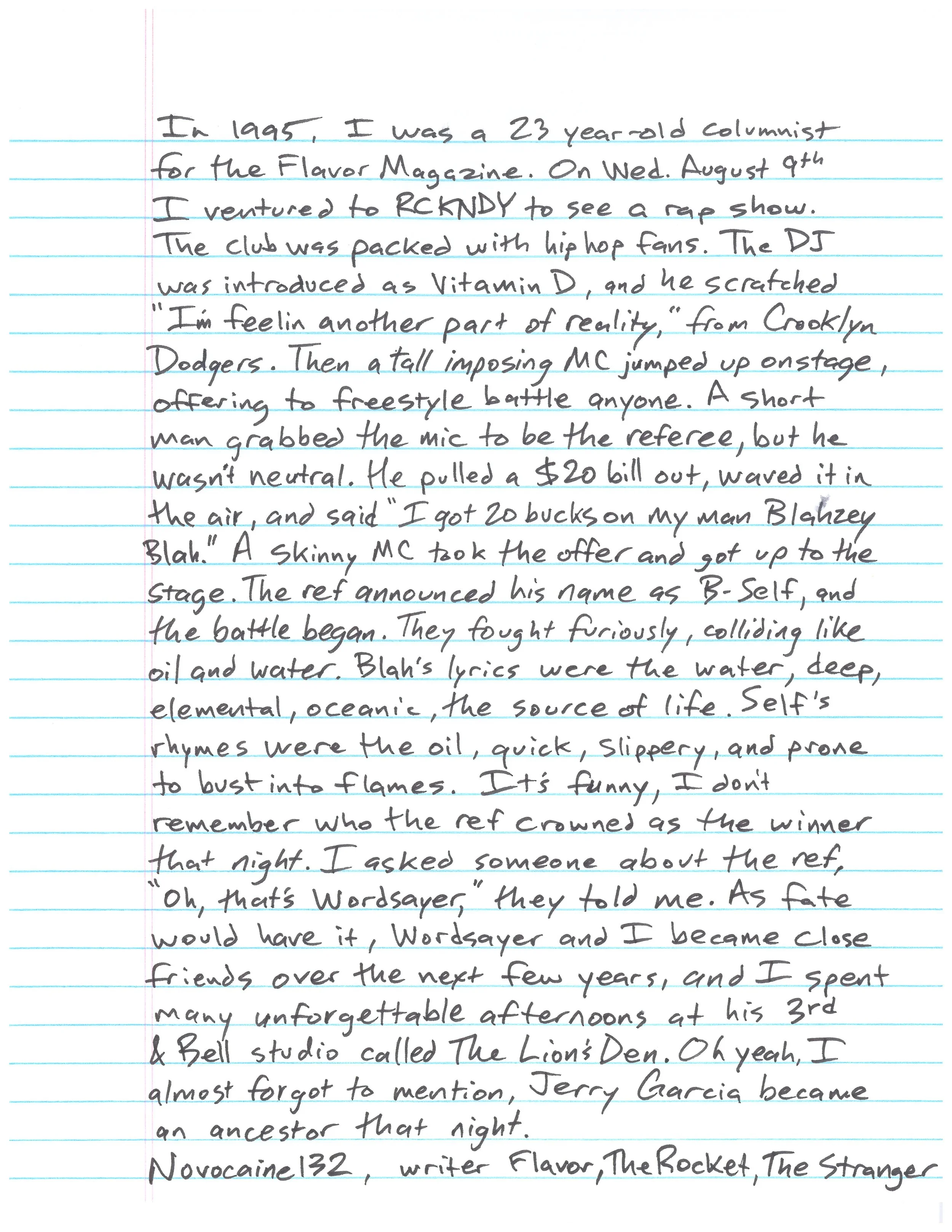
In 1995, I was a 23-year-old columnist for The Flavor magazine. On Wednesday, August 9th, I ventured to Rock Candy to see a rap show. The club was packed with hip-hop fans. The DJ was introduced as Vitamin D, and he scratched, "I'm feeling another part of reality" from Crooklyn Dodgers. Then, a tall, imposing MC jumped up on stage, offering to freestyle battle anyone. A short man grabbed the mic to be the referee, but he wasn't neutral. He pulled a $20 bill out, waved it in the air, and said, "I got 20 bucks on my man, Blasé Blas." A skinny MC took the offer and got up to the stage. The ref announced his name as B-Self, and the battle began. They fought furiously, colliding like oil and water. Blasé's lyrics were the water, deep, elemental, oceanic, the source of life. Self's rhymes were the oil, quick, slippery, and prone to bust into flames. It's funny, I don't remember who the ref crowned as the winner that night. I asked someone about the ref. "Oh, that's WordSayer," they told me. As fate would have it, WordSayer and I became close friends over the next few years, and I spent many unforgettable afternoons at his 3rd and Bell studio called the Lion's Den. Oh yeah, I almost forgot to mention, Jerry Garcia became an ancestor that night.